
The Hero’s Choice
The Reincarnated Demon King's Host Just Wants to Live in Peace, But the Hero Won't Leave Him AloneLuc grows from a child trained to obey the Heroic mission into an adult who defines heroism through love, consent, and chosen responsibility.
increasing Bearing strength in each event
 decreasing
Bearing strength in each eventdecreasingA Child Selected
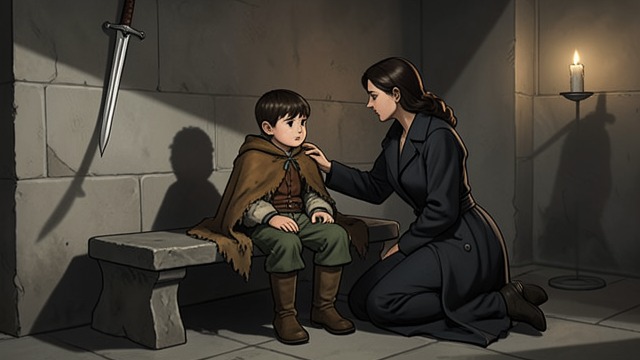
A Child Selected
Loss becomes recruitment
After his healer mother dies, Luc is taken to The Capital by Eliza, his aunt and the previous Hero. His inherited Hero magic sets him on a training path before he can understand what it will cost.
Protection and control entwined
Eliza’s care comes with a duty that leaves little room for ordinary childhood. Luc grows up knowing that his strength is valued because it can serve a mission, while his own wishes remain secondary.
The arrangement produces a capable Hero but also establishes the conflict that will later break between them: whether love and family justify controlling another person’s future.
The Hero’s Training

The Hero’s Training
Power with a price
Luc’s Hero magic improves his speed, strength, resilience, and resistance to magic, but it burns through his body and life force. Training from a young age prepares him for combat without making the mission less dangerous.
A public role takes shape
As Hero of Algeya, Luc learns to lead a party and pursue the demons. Yet he is also a young man with grief, longing, and a wish for a peaceful future beyond the title.
The contrast between his public function and private hopes becomes increasingly important once he meets Theo. Luc’s strength is formidable, but his deepest choices will require refusing the role’s claim to his whole life.
A Wound from Eliza
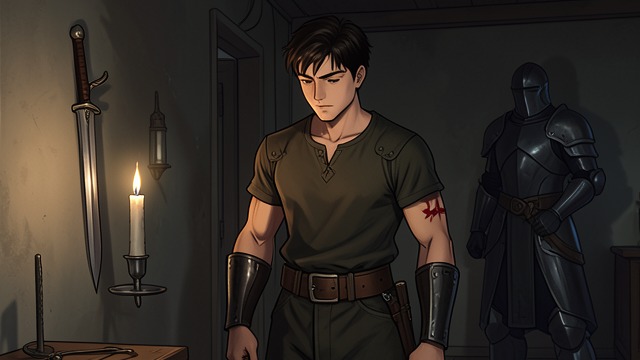
A Wound from Eliza
Discipline imposed as punishment
Eliza catches Luc slacking during training, takes the Hero’s sword from him, and leaves a serious wound untreated as a reminder of duty. The injury teaches Luc that even family affection can be used to enforce obedience.
A cost carried into adulthood
Luc later tells Theo that the scar came from Eliza, revealing how deeply her control shaped his understanding of service. His body bears evidence of a system that praises sacrifice while treating pain as instruction.
The memory helps explain Luc’s fear of failing the mission, but it also prepares him to recognize that authority is not the same as care.
Love Against the Mission
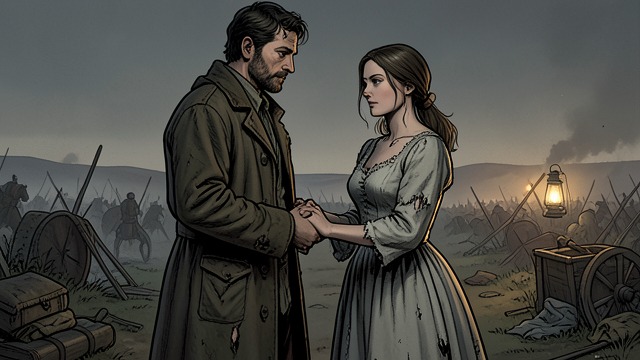
Love Against the Mission
A private bond becomes a choice
Luc refuses to leave Theo behind when the party resumes its quest. Their relationship gives him a future that is not defined by battle, and he no longer accepts the idea that affection must always yield to duty.
A public break with Eliza
At departure, Luc tells Eliza that defeating the demons will end his service as Hero. He rejects her attempt to preserve a bloodline and names his own right to choose his life.
The declaration turns a private romance into a direct challenge to the institution that shaped him. For Luc, love does not cancel responsibility; it reveals that responsibility cannot be separated from free will.
A Deferred Sentence
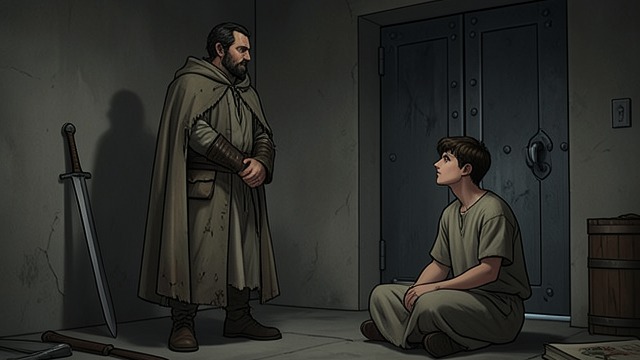
A Deferred Sentence
Duty reinterpreted
Luc says he must eventually kill the Demon King, then asserts that the timing belongs to him. He chooses to wait until he and Theo have lived a full life together rather than execute Theo for the soul he hosts.
The Hero’s role transformed
He declares that the world no longer needs a Hero to purge demons and presents himself as Theo’s guard. Instead of repeating the duty system, he imagines a future in which those born with Hero magic may decide what their lives mean.
His choice is both personal and political. He does not deny the danger Malthios represents; he insists that judgment should attend to actions and that a life of love can coexist with vigilance.
When Luc is five years old
From childhood through Luc’s early adulthood
When Luc is about twelve
After Luc and Theo reunite in The Capital
At the end of Theo’s trial
